Showing posts with label London. Show all posts

Thursday, July 29, 2010

King's College Maughan Library Tour


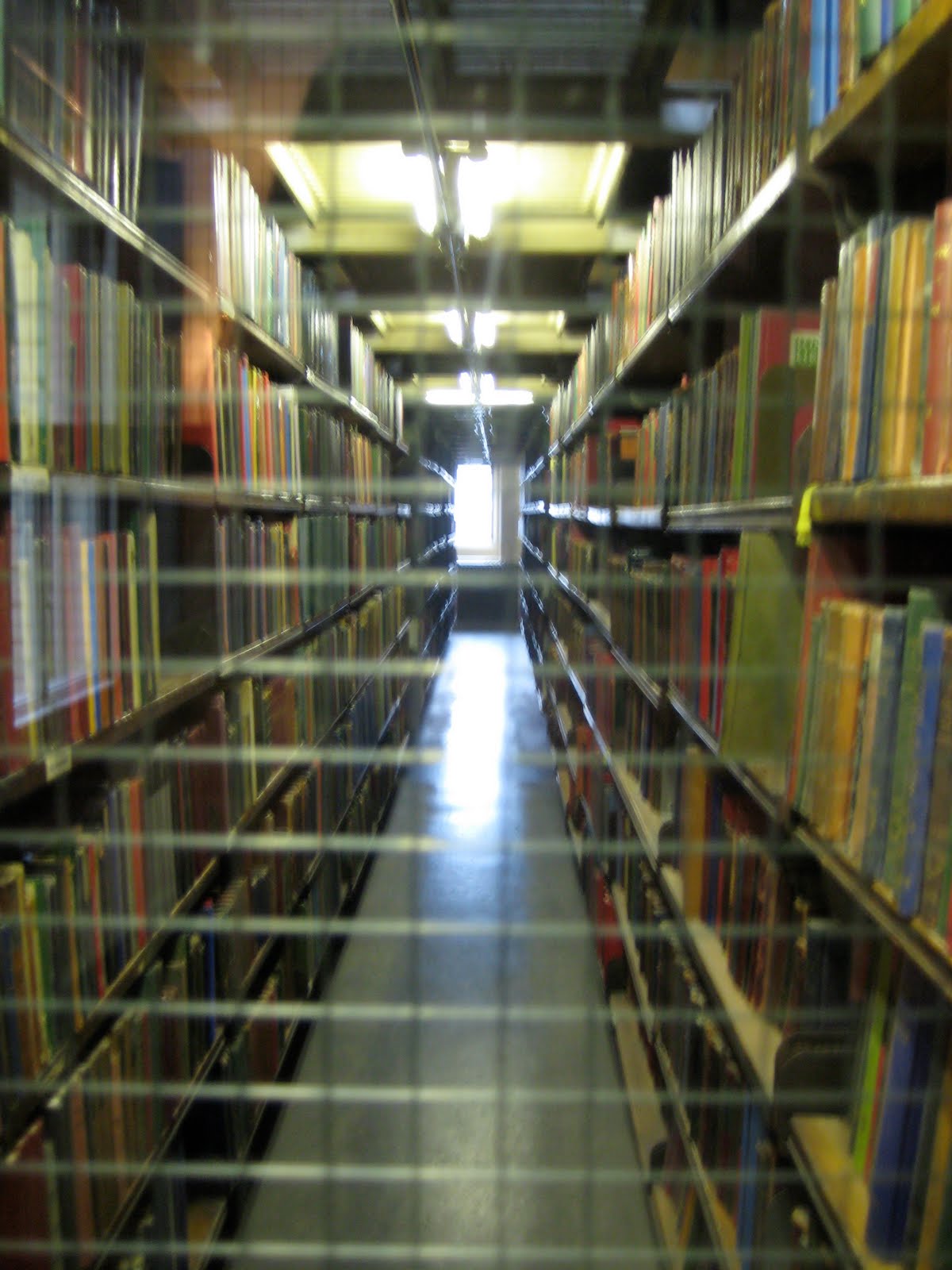
The final tour we took as part of this trip was to the King's College Maughan Library. For me, this tour held particular interest because I have done some exploring of the Franklin-Wilkins café and Information Services Centre, and also because of the way the library, housed in a quintessentially Victorian building, is adapting to current trends in library services to best meet the need of their 21st century users.

The Maughan Library holds 3/4 of a million items, has seating for about 1,000 students, and computer stations for about 300 students. The Library serves the Strand campus of King's College, and has close relationships with the University of London, among others, and extends access to affiliates of these universities. In addition to housing the Foyle Special Collections Library, the Library holds legal, music, humanities, and natural science materials, as well as films and audio recordings in various formats, all of which support the studies of students on the Strand campus.

The Library moved into its current home, the old Public Record Office building, in 2001. The building was designed to hold a large volume of paper-based materials, and consequently, its load-bearing capability did not have to be enhanced. Many restrictions applied to the renovation of the building, because of its age and historic importance, but the resultant spaces were very clean and tastefully decorated, if a little confusing to navigate.

The library is putting into place several further innovations in its services. They have already installed wi-fi in the building, and are in the process of implementing RFID technology and self-checkout stations, bringing staff away from service desks to provide roaming services, and creating more collaborative student work spaces to complement their silent study spaces. I was interested to see that these services were chosen for the mix of new services, because these are all innovations I have seen becoming widespread, not so much in university libraries, but in UK and US public libraries, which are generally well-attuned to their users' wants and needs and committed (budget permitting) to satisfying these needs.

Another innovation I noticed before visiting the library. As part of the research for my final paper, I had looked the King's College Libraries up online, and had discovered that they fell under the umbrella of Information Services Centres. This was a term I was unfamiliar with, so I looked it up: on the ISCs and Libraries webpage, it says

Information services centres (ISCs) and libraries, situated across all campuses, provide access to multi-disciplinary print and electronic information resources and local IT services.


I am intrigued by this concept: on one hand, it suggests that libraries are primarily providers of books, but it ties them in tightly information-related services that students will need and use. It would seem some other people are grappling with the idea: at Franklin-Wilkins, there is a white address label with "Library" written on it in green sharpie next to the ISC label on the building's floor directory. Part of the difficulty in innovations, even if they are good ones, is more than securing funding or staffing to remodel buildings and RFID tag books: people are used to the old way of doing things whether or not the old way is "best."

Friday, July 16, 2010

National Art Library Tour


Visiting the National Art Library was a very interesting experience. By now, we have visited a few libraries or archives that live inside other institutions: St. Paul's Cathedral Library, British Museum General Archive, National Maritime Museum Library. Each of these has different but largely positive relationships with their partner institutions. However, the National Art Library seemed to be more tenuously tied with the Victoria and Albert Museum, whose space it shares, than the other institutions.

The National Art Library is open to the public, and most of the materials are closed access--in other words, a librarian must retrieve them for patrons. Patrons can then view their items in the Library's two reading rooms, one of which is for silent study and the other which allows collaborative study. The Library has an online catalog, but there is no remote access, and access to rare materials in the collection is only allowed if the patron can provide sufficient credentials and need to access the material.

While the National Art Library had an extensive collection of periodicals, exhibition and auction catalogs, and books to do with art, as well as rare books, it has very little space and a tightly restricted budget. As a result, the library has had to devise creative solutions to fit all its materials in the space it is allotted and shares the Victoria and Albert Museum's Conservation department.

This arrangement was very surprising to me, especially given the mission statement on the Victoria and Albert Museum's "About Us" page:

The purpose of the Victoria and Albert Museum is to enable everyone to enjoy its collections and explore the cultures that created them; and to inspire those who shape contemporary design.

All our efforts are focused upon a central purpose - the increased use of our displays, collections and expertise as resources for learning, creativity and enjoyment by audiences within and beyond the United Kingdom.


To me, that statement all but shouts for close interaction with and strong support of a library. A library aids scholarship by providing a body of knowledge that complements what can be learned from Museum objects themselves. A library provides background that allows scholars to understand the materials used to create a piece of art and how that piece fits into the history of art and of society as a whole. Even more, a library contains materials that will help the museum better share their collections with the public--books on museum studies, community relations, and principles of education. For all these reasons, I hope the National Art Library, with all its valuable resources, soon takes its rightful place as a mutual partner with the Victoria and Albert Museum with its mission of bringing art to the public.

Tuesday, July 13, 2010

London Library Tour


Image: Miniature books in a glass-fronted bookcase at the London Library

On today's tour, we visited the London Library. This library was unlike any other I've ever visited, either here in London or in the U.S.

Much of its uniqueness stems from the fact that it is not a public or university library, but an independent and member-funded institution. Our tour was broken into three segments: the tour of the building was led by deputy librarian Jane Oldfield, while librarian Helen O'Neill discussed the history of the Library and the Library as an institution, and Stella Worthington gave a summary of the work done by the relatively new Conservation department.

The library was founded in 1841 by Thomas Carlyle, who was unhappy with the fact that materials at the British Library were strictly for reference use. Over the years, many distinguished authors have been members of the library, and many contributed part or all of their personal libraries to the London Library after their deaths. Currently, the library has approximately 7,500 members, including organizations--such as the Houses of Commons and Lords--researchers, and writers. The forcus of the Library's collection is primarily on humanities, with a little on the history of science and natural sciences.

As we learned during Oldfield's portion of the tour, the Library is winding up the most recent of the redevelopment projects it has undertaken over the years since its existence. This current redevelopment project focused on consolidating the four buildings the Library has grown to fill and adding in features to enhance user friendliness, such as a brighter mezzanine in the Art Library and lockers in the Library entrance.

Part of the reason the library has grown to fill all these buildings is that they never discard items. In addition, they circulate 97% of the collection, which covers books from 1700 onwards. As can be imagined, this means the library has a very real need for conservation, which resulted in the creation of a conservation lab and hiring of a conservator by Worthington, the Preservation and Stack Management Librarian.


Image: 19th century steel floored stacks.

The London Library has many idiosyncrasies, including its cataloging system, which was devised in the 19th century by Library Director Sir Charles Hagberg Wright. However, the librarians were all very confident in the decisions they made in the management of the library and its collections, a confidence which I believe stems from their independence from the demands of other departments and insecurity of funding that so often comes when libraries are part of city or university systems. As an employee of a city library very much dependent upon the fortunes of the city it is attached to, I envy the London Library the freedom they have to embrace their uniqueness and make it their greatest strength.

Monday, July 12, 2010

National Maritime Museum Library


Although my interests cover an eclectic range of topics, I have never had occasion to delve into nautical history--with the exception of the short forays in books like Treasure Island. Our visit to the National Maritime Museum's Caird Library, then, was a unique opportunity to learn about a very specialized topic.

Our tour leader, Hannah, explained that the National Maritime Museum's Caird Library's founding collection was donated by Sir James Caird in 1937, and that the collection now encompasses topics such as emigration, navigation, piracy, astronomy, voyages and expeditions, naval architecture, the Merchant Navy, the Royal Navy, and genealogical services. The Library's collection encompasses modern books (1850-present), rare books (pre-1850), charts, letters, ephemera, and other two-dimensional items. Hannah's colleague, Martin, noted that the Library focuses on collecting personal items, while government records are left to the National Archives. Hannah also noted that the Library is used with equal frequency by lecturers, Master's and PhD candidates, and family history researchers.

Currently, the Library's reading room, where the modern books are stored, is a very traditional room with beautiful glass-fronted wooden shelves, and the librarians and archives have use a traditional paper-based method of recording document requests. However, the Library is in the process of creating a new, larger space to house their library and archival collections. When completed, they will have more space for their collections, a new automated system for tracking document requests, and a reading room that will both offer more space for researchers and heighten the visibility of the library.

To finish their tour, Hannah and Martin showed our group a selection of items from the Library's collections, explaining the significance of each. The items ranged from a copy of a set of Spanish charts made by 16th century British pirates to an illustrated book of poetry, fiction, and nonfiction written, printed, and bound by Shackleton's team of explorers in Antarctica. These items amply illustrated the history of exploration, piracy, and of England itself as it unfolded on the seas, and made me eager to learn more about this aspect of British history.

The Globe


This Sunday, I went to the Globe to see a production of Shakespeare's King Henry IV, Part 1. It was great fun: the building was true to the original, as were the sets, and the director went a long way to ensure that the tone of the play was also faithful to a 17th century production.

Working in a library, visiting libraries, it's easy to forget that the the printed word, for all its ability to capture and preserve histories, feuds, and plays, is not always the supreme medium. When I first encountered King Henry IV in the printed form, it seemed a little formal and dull.


That is not the case in the actual production. A bawdy mummer's play began the production and songs bracketed the acts. Even with minimal sets, the actors brought both the humor and the conflict in the story to life. After seeing this performance, I am now convinced that a place like the Globe that keeps the tradition and art of performing these plays alive is just as valuable as the First Folio in the British Library's Treasure Collection.

Monday, July 5, 2010

St. Paul's Cathedral Tour


Image source: http://www.stpauls.co.uk/Cathedral-History/The-Library

On today's tour, we visited the Saint Paul's Cathedral Library and toured the upper floors and library with librarian Joseph Wisdom.

While my current focus in librarianship is academic librarianship, I was an anthropology major as an undergrad, focusing on archaeology, and have taken graduate courses on preservation and the history of the book, so I suppose I am also looking longingly at special collections. As a consequence of my academic background, I often find myself looking at the book as an object--often, its symbolism is just as interesting as the information written inside.

Wisdom introduced us to the Cathedral by pointing to a carving above the entrance depicting a stone book flanked by two cherubs. The book was blank--the symbol of the book, not any written words, were the most important thing to the designer of the carving. While waiting for the tour to begin, I found many other symbols, most of which were symbols of power. The symbols of power were associated primarily with God and Christianity, but also the intellectual, military, or political power of the people memorialized inside. The symbols included durable marble and metalwork, costly gilding, and, incorporated into memorial statues and plaques, books and scrolls.

Almost since its inception, Christianity has been the religion of the book, and similarly, St. Paul's has always had a library. As part of the tour, we visited two upper rooms, one which housed Wren's model of the Cathedral's original design and several architectural drawings of the Cathedral (the Fabric Archive) and the other which housed the Library. Wisdom pointed out carvings of books and quill pens in the scrollwork that showed that the connection between Christianity and books had been made by the builders in these upper rooms as well.

In the Library, Wisdom noted how central an understanding of the depth of time was to his work: one instance of this is keeping the various catalogs that have been created for the Library collection. These document the history of the Library, as well as items that the Library may no longer own--such as the volumes that were lost when the previous St. Paul's burnt down.

Nowhere was this depth of time more evident than in the beautifully illuminated manuscript psalter that Wisdom brought out for us to view. Both its handwritten and hand-decorated pages and deep, distinctive scent seemed to epitomize age. Listening to Wisdom describe his work, I was surprised to learn how much it strayed into curation. Part of Wisdom's job is to measure the heat and relative humidity in both the Fabric Archive and the Library, and his description of discovering the provenance, or history, of the psalter, was almost exactly the same approach as archaeologists take when puzzling out the significance of their findings.

Once I started looking at the library as a place to be curated, I found challenges to this goal everywhere--the collection included not just the manuscript but also printed books, both housed in a historical building. To add to this difficulty, St. Paul's is a functioning cathedral that cannot be dissected or torn apart to seal cracks, put in a new particle filtering ventilation system or close up windows letting in light. In spite of these challenges, Wisdom was enthusiastic about his work and about sharing its unique characteristics with us.

Sunday, July 4, 2010

Snappies Versus Photographs


Hello! I'm Allison, and this is the blog I will be keeping as part of my coursework for the USM British Studies Program.

As you might have inferred, I am very pleased to be here, and over the years watching British TV programs, reading British books, watching British movies and listening to British bands, I have amassed a small arsenal of British English words with which to express this and many other things besides.

I have maintained another blog, Shop on the High Street, for a few years now, but I chose to add this blog to divide the two different types of blogging I hope to do while in London. Photography is another one of my hobbies, and similarly, I take two types of photography I engage in. On one hand there are the snappies, quick photographs snagged on the street in just a little time and often with little care. On the other are the photographs, images that I carefully compose in my mind's eye to bring together the lines, colors, and shadows so they capture for the next viewer what caught my eye.

In the same way, Shop on the High Street will be where I chronicle little snappies of my month, quick and unstudied impressions. Here, on Chuffed!, is where I will take the time to focus my mental images in an attempt to capture what I see so I can better its beauty or significance for others.

To ground these experiences in the context of their place, I have included a map of several of the places I will visit in class and in the course of my own exploration, and a BBC weather widget for London. Living in a consistently hot, dry, place, I know I was surprised at how often London weather changes!

Thank you for reading--I hope you are just as chuffed to see London as I am!